
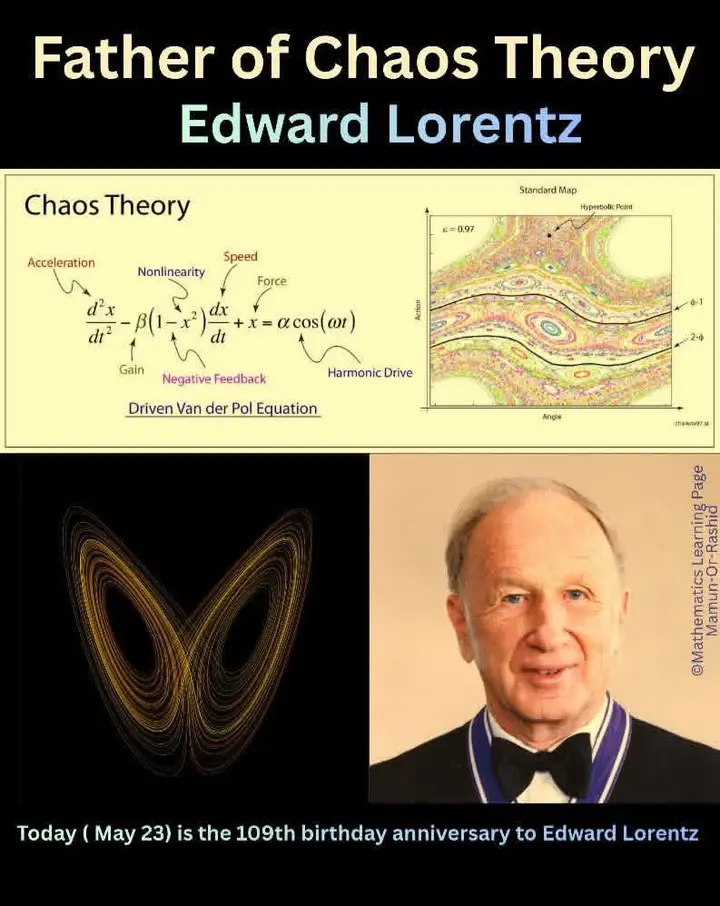
إدوارد لورنز: أبو نظرية الفوضى
نظرية الفوضى هي دراسة الأنظمة التي تبدو عشوائية وغير قابلة للتنبؤ، ولكنها في الواقع تخضع لأنماط كامنة وقوانين حتمية. تكشف هذه النظرية عن فكرة منافية للمنطق: أنه حتى عندما يتبع النظام قواعد دقيقة، قد يكون من المستحيل التنبؤ بمستقبله. فما يبدو فوضى ليس في كثير من الأحيان عشوائية حقيقية، بل تعقيد يتجاوز قدرتنا على الحساب والتنبؤ.
يكمن جوهر نظرية الفوضى في الحساسية للظروف الأولية، والتي غالبًا ما تتجلى من خلال “تأثير الفراشة”، وهو مصطلح شاع استخدامه بفضل إدوارد لورنز. أثناء عمله على نماذج الطقس، اكتشف لورنز أن تغييرًا طفيفًا في قيمة ابتدائية يؤدي إلى نتائج مختلفة تمامًا. ومن هنا انبثقت فكرة أن التغيرات الطفيفة في بداية أي عملية يمكن أن تنمو بشكل متسارع مع مرور الوقت، لتُنتج في النهاية نتائج تبدو غير مترابطة تمامًا. هذا يعني أن التنبؤ طويل المدى، حتى في الأنظمة التي تخضع لقوانين صارمة، يصبح شبه مستحيل.
مثّلت هذه الرؤية قطيعةً مع التفاؤل العلمي السابق المتجذر في فكر علماء مثل إسحاق نيوتن وبيير سيمون لابلاس. فقد أوحت قوانين نيوتن بوجود كون يتصرف كآلة يمكن التنبؤ بها بدقة، بينما تخيّل لابلاس ذكاءً، إذا ما امتلك المعرفة الكاملة بجميع القوى والمواقع في الكون، فإنه قادر على استشراف المستقبل برمته. تقوّض نظرية الفوضى هذه الرؤية، مُبيّنةً أنه حتى مع المعرفة الكاملة بالقواعد، قد يفشل التنبؤ لأن الأنظمة تُضخّم الشكوك الصغيرة الخارجة عن السيطرة.
يمكن تتبع أسس نظرية الفوضى إلى هنري بوانكاريه، الذي درس حركة الأجرام السماوية وأدرك أن حتى أبسط الأنظمة الجاذبية يمكن أن تتصرف بطرق تتحدى التنبؤ الدقيق. وقد ألمح عمله إلى كون أكثر تعقيدًا وعدم استقرار مما افترضته الفيزياء الكلاسيكية، مما مهّد الطريق لتطورات لاحقة في الديناميكا غير الخطية.
من الناحية الفلسفية، تُعيد نظرية الفوضى تشكيل طريقة تفكيرنا في النظام والفوضى. فهي تُشير إلى أنهما ليسا نقيضين، بل متداخلان بعمق. تحت ظاهر العشوائية، غالبًا ما تكمن بنى خفية – أنماط لا تتكرر بدقة، ومع ذلك تظل محددة ومتماسكة. تُوصف هذه الأنماط أحيانًا بـ”الجاذبات الغريبة”، وهي أشكال تجسد فكرة النظام الناشئ من رحم اللاتوقع.
يُلاقي هذا المنظور صدىً لدى العديد من الفلاسفة المعاصرين. فقد أكد فريدريك نيتشه على الطبيعة السائلة والمتغيرة باستمرار للواقع، رافضًا فكرة الكون المستقر والمنظم. وتعكس مقولته الشهيرة عن الحاجة إلى الفوضى في الذات لولادة نجم راقص حدسًا بأن الإبداع والتحول ينبعان من عدم الاستقرار لا من النظام الجامد. وبالمثل، استكشف جيل دولوز وفيليكس غاتاري أفكار التعددية واللاخطية والأنظمة الديناميكية، مصورين الواقع كشبكة من العلاقات المتغيرة باستمرار بدلًا من بنية ثابتة. وقد وسّع ميشيل سير هذه الأفكار لتشمل فلسفة أوسع للاضطراب، مجادلًا بأن المعرفة نفسها تنبثق من الفوضى والضوضاء لا من الوضوح التام.
كما تُعقّد نظرية الفوضى الجدل الدائر منذ زمن طويل بين الحتمية والإرادة الحرة. يُظهر هذا أن النظام قد يكون محكوماً بالكامل بالقوانين، ومع ذلك يظل غير قابل للتنبؤ به عملياً. وهذا يخلق حالة وسطية غريبة، حيث يكون المستقبل ثابتاً من حيث المبدأ، لكنه مجهول في الواقع. بالنسبة للحياة البشرية، يشير هذا إلى أنه حتى لو كانت أفعالنا نابعة من أسباب سابقة، فإن تعقيد تلك الأسباب يجعل النتائج مفتوحة وغير مؤكدة.
بعيداً عن الفلسفة، تحمل نظرية الفوضى آثاراً عميقة على فهمنا للعالم. فالأنظمة المناخية، والنظم البيئية، والأسواق المالية، وحتى المجتمعات البشرية، جميعها تُظهر سلوكاً فوضوياً. يمكن لأحداث صغيرة أن تتفاقم لتُحدث عواقب وخيمة، وغالباً ما تفشل محاولات فرض سيطرة صارمة لأنها تتجاهل التعقيد الكامن. هذا لا يعني أن هذه الأنظمة بلا نظام، بل يعني أن نظامها دقيق وديناميكي ومتطور باستمرار.
في نهاية المطاف، تُقدم نظرية الفوضى نظرة متواضعة للواقع. فهي تتحدى الاعتقاد بإمكانية التنبؤ بالعالم أو السيطرة عليه بشكل كامل، وتستبدله بتقدير لعدم اليقين والتعقيد. وفي الوقت نفسه، يكشف عن نوع من الجمال الخفي: عالم تنشأ فيه الأنماط من الفوضى، حيث يتعايش الاستقرار وعدم الاستقرار، وحيث يمكن لأصغر الأفعال أن تنتشر إلى الخارج بطرق لا يمكننا توقعها بالكامل.
EDWARD LORENTZ: THE FATHER OF CHAOS THEORY 🌹❤️♥️
Chaos theory is the study of systems that appear random and unpredictable, yet are actually governed by underlying patterns and deterministic laws. It reveals a deeply counterintuitive idea: that even when a system follows precise rules, its future can still be impossible to predict. What looks like disorder is often not true randomness, but complexity that exceeds our ability to calculate and foresee.
At the heart of chaos theory is sensitivity to initial conditions, often illustrated through the “butterfly effect,” a term popularized by Edward Lorenz. While working on weather models, Lorenz discovered that an almost insignificant change in a starting value led to completely different outcomes. From this came the insight that tiny variations at the beginning of a process can grow exponentially over time, eventually producing results that seem entirely unrelated. This means that long-term prediction, even in systems governed by strict laws, becomes practically impossible.
This insight marked a break from earlier scientific optimism rooted in thinkers like Isaac Newton and Pierre-Simon Laplace. Newton’s laws suggested a universe that behaved like a perfectly predictable machine, while Laplace imagined an intelligence that, if it knew all forces and positions in the universe, could foresee the entire future. Chaos theory undermines this vision, showing that even with complete knowledge of the rules, prediction can fail because systems amplify tiny uncertainties beyond control.
The foundations of chaos theory can be traced back to Henri Poincaré, who studied the motion of celestial bodies and realized that even simple gravitational systems could behave in ways that defied precise prediction. His work hinted at a universe far more complex and unstable than classical physics had assumed, laying the groundwork for later developments in nonlinear dynamics.
Philosophically, chaos theory reshapes how we think about order and disorder. It suggests that these are not opposites, but deeply intertwined. Beneath apparent randomness, there are often hidden structures—patterns that never repeat exactly, yet remain bounded and coherent. These are sometimes described as “strange attractors,” forms that capture the idea of order emerging within unpredictability.
This perspective resonates with several modern philosophers. Friedrich Nietzsche emphasized the fluid, ever-changing nature of reality, rejecting the idea of a stable, orderly universe. His famous line about needing chaos within oneself to give birth to a dancing star reflects an intuition that creativity and transformation arise from instability rather than rigid order. Gilles Deleuze and Félix Guattari similarly explored ideas of multiplicity, nonlinearity, and dynamic systems, portraying reality as a network of constantly shifting relations rather than a fixed structure. Michel Serres extended these ideas into a broader philosophy of turbulence, arguing that knowledge itself emerges from disorder and noise rather than from perfect clarity.
Chaos theory also complicates the long-standing debate between determinism and free will. It shows that a system can be fully determined by laws and yet remain unpredictable in practice. This creates a strange middle ground where the future is fixed in principle but unknowable in reality. For human life, this suggests that even if our actions arise from prior causes, the complexity of those causes makes outcomes open-ended and uncertain.
Beyond philosophy, chaos theory has profound implications for how we understand the world. Weather systems, ecosystems, financial markets, and even human societies all display chaotic behavior. Small events can cascade into major consequences, and attempts to impose rigid control often fail because they ignore the underlying complexity. This does not mean that such systems are without order, but rather that their order is subtle, dynamic, and constantly evolving.
Ultimately, chaos theory offers a humbling view of reality. It challenges the belief that the world can be fully predicted or controlled, replacing it with an appreciation for uncertainty and complexity. At the same time, it reveals a kind of hidden beauty: a world where patterns emerge from disorder, where stability and instability coexist, and where the smallest actions can ripple outward in ways we can never fully anticipate.
#فيثاغورث#مجلة ايليت فوتو ارت..