World Photography Day: A Look Back, and a Gaze into the Future
Perhaps, ever since human beings first opened their eyes to the world, we have never been content merely to see things. We have wanted, somehow, to keep them from disappearing.
We look upon a face we love and fear what time may do to it. We look upon a city and know that one day it will change. We hear a child laugh and understand — even if we never say it aloud — that the same laughter, in precisely the same moment, will never return.
Out of this ancient human desire to resist the passing of things arose the long and wondrous story whose beauty we celebrate today:
the story of photography.
And what a remarkable story it has been.
It began in a darkened room and has brought us — for now — to a machine that can see with us, calculate for us, and perhaps, tomorrow, even learn to imagine alongside us.
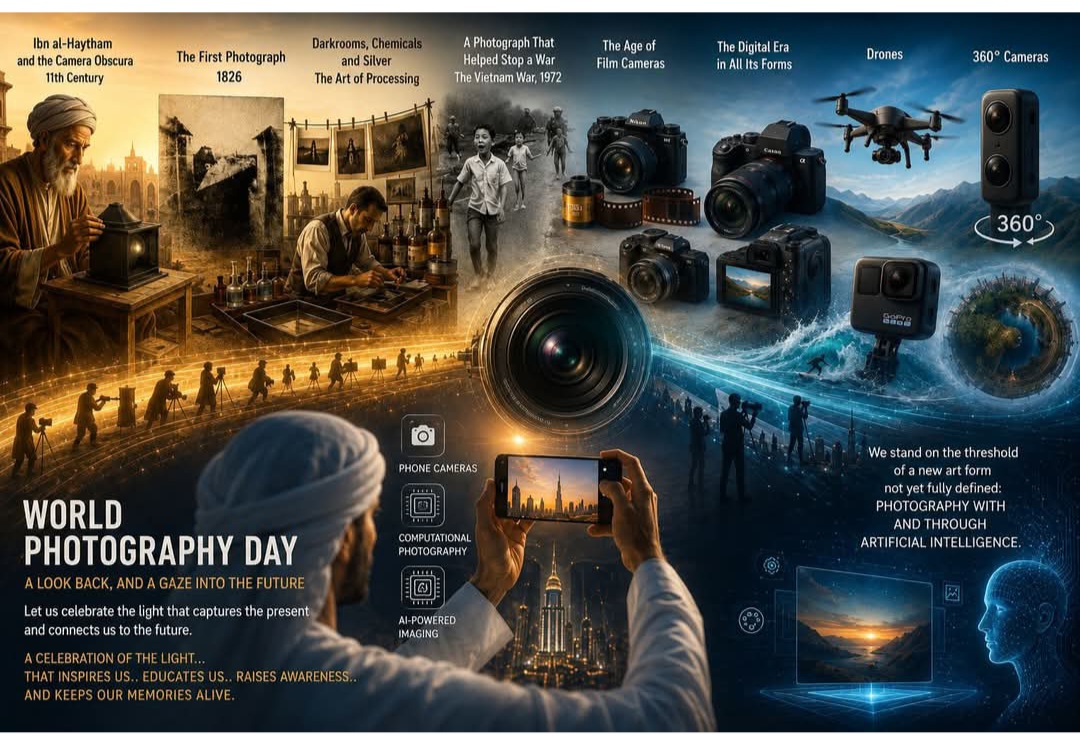
More than a thousand years ago, Ibn al-Haytham contemplated light — that mysterious visitor that enters every home, yet can only be seen through what it reveals.
Through his experiments with the camera obscura, the darkened chamber and the tiny opening through which light passed, he laid one of the great foundations for understanding how images are formed.
There was no camera in his hands as we understand the word today. He was not waiting for a photograph to hang upon a wall.
He was doing what every true pioneer does:
opening a door without knowing how far the road beyond it would someday reach.
Centuries passed.
Then came a time when humanity could finally say to light:
Do not merely pass through.
Stay awhile. Leave something of yourself behind.
In the 1820s, Joseph Nicéphore Niépce succeeded in fixing one of the earliest surviving permanent photographs. It was a simple view from a window — an image that might appear modest to modern eyes.
Yet something extraordinary had happened.
Humanity had found a way to hold on to a moment after the moment itself had gone.
And from there, photography began its magnificent journey.
Then came an age in which the photographer practised something almost resembling the rituals of an alchemist.
A camera. Film. Carefully measured light. A darkroom. Chemicals. Trays. Paper waiting silently for its image.
And silver became light’s companion in this extraordinary craft. Silver-halide crystals preserved the trace of illumination; exposed films entered darkrooms and laboratories, and photographers waited.
How beautiful waiting once was when a photograph required patience.
There was no screen on the back of the camera to tell you whether you had succeeded or failed. There was no delete button. No endless burst of images from which to choose.
Every frame had a cost.
And pressing the shutter carried a certain gravity.
Then came the magic.
A blank sheet of photographic paper entered the developer, and slowly something began to emerge: an eye, perhaps; then a face; then a sky; until an entire world appeared from whiteness.
Those who knew the darkroom remember a kind of wonder that is difficult to explain to generations born into a world where photographs appear instantly.
A photograph in those days was not simply taken.
It was born.
Then photography left the studio and the family album and went out into the streets, into newspapers, and onto battlefields.
And there the world discovered that a photograph was more than a keepsake.
It could be testimony.
A single image could sometimes say what thousands of pages could not.
During the Vietnam War, Nick Ut photographed nine-year-old Phan Thi Kim Phuc in 1972 as she fled, badly burned, after a napalm attack.
That photograph did not, by itself, end the Vietnam War — history is far too complex to be reduced to a single frame — but it became one of the defining images that shocked the world’s conscience and deepened public opposition to the war.
A child was running down a road.
But behind her, an entire age was being questioned about the meaning and cost of war.
Photography had reached one of the highest expressions of its purpose.
It no longer said only:
Look how beautiful the world is.
It could now cry out:
Look at what is happening in the world — and do not turn your face away.
The years turned, and film cameras entered ordinary life.
Family cameras. Instant cameras. Compact cameras. Rolls of 24 or 36 exposures.
We carried them on holidays, to weddings, into classrooms and on journeys. At the end of a trip, we would hand a roll of film to the photo lab as though we were handing over a small sealed box of memories.
Then we waited.
Days later, the envelope would return.
We laughed at the photograph in which someone had blinked. We regretted the frame ruined by light. And we celebrated the unexpected image that somehow came back more beautiful than we had imagined.
There was something lovely even in those mistakes, because they resembled life itself:
there was no undo button.
Then came digital photography.
And within a remarkably short time, everything changed.
The photograph moved from the realm of chemistry and silver into the realm of sensors, pixels, memory cards and files.
Film gradually disappeared from everyday use. Darkrooms and processing laboratories vanished from many of our streets. The photograph appeared the very instant it was taken.
And cameras multiplied and specialised.
Professional cameras, DSLRs, mirrorless systems, compact cameras, action cameras, underwater cameras and countless other forms.
Then we began sending cameras where photographers themselves could not easily go.
We attached them to the helmets of climbers, mounted them on surfboards and carried them beneath the waves. GoPro and other action cameras gave adventure an eye of its own.
Then we gave the camera wings.
Drones lifted photography above our heads, and suddenly we saw our cities, deserts, coastlines and mountains almost as birds might see them.
Then came 360-degree cameras.
The photograph no longer had to say, “This is what stood before the photographer.”
It could say:
“This is the world that surrounded the photographer.”
What would have seemed like fantasy only decades earlier became a device small enough to carry in a bag.
And then photography arrived at perhaps its most consequential destination:
the smartphone.
Everything changed again.
The camera that had once been a large wooden box, then an expensive instrument, then a machine hanging from a professional photographer’s neck, now lived inside the pockets of billions of people.
Yet the true revolution was not merely that the lens had become smaller.
We had entered the age of computational photography.
The camera was no longer simply a lens receiving light. It had become a system that sees and calculates; that combines exposures, recognises faces, distinguishes sky from earth, stabilises movement, reconstructs detail and produces photographs in near-darkness that earlier generations of photographers might have considered impossible.
Part of the photograph was now being made after the light entered the lens.
And so the question began to change.
Once, we asked:
What did the photographer see?
Then we began asking:
How did the camera see it?
Today, we are approaching a stranger and more profound question:
What did the human see — and what did the machine complete?
And here, on World Photography Day, we find ourselves standing at the threshold of another age — one for which we do not yet possess a name large enough to contain it.
It is the age of photography in the presence of artificial intelligence — and with its assistance.
We may not be exaggerating when we say that a new art form is being born before our eyes.
Its features, however, are not yet clear.
Artificial intelligence can already help photographers select images, enhance light, remove noise, restore detail, search millions of photographs, organise archives and process images in ways that would have been unimaginable only a few years ago.
And it has gone further.
It can now generate images of things before which no camera has ever stood.
At this point, the transformation becomes more than technological.
It begins to touch the very meaning of the photograph.
What, now, is a photograph?
Is it the trace of light?
The trace of vision?
Or the trace of imagination?
And who will the photographer of tomorrow be?
The person who presses the shutter?
The person who chooses the moment?
The person who conceives the idea?
Or perhaps the person who enters into a creative dialogue with a machine capable of transforming language into imagery?
We do not yet know.
And perhaps there is something beautiful in not knowing.
Great art forms rarely arrive in the world carrying an instruction manual.
And so World Photography Day is not merely a celebration of the camera.
It is a day of gratitude.
Gratitude to Ibn al-Haytham as he traced the path of light.
To Niépce as he waited patiently for light to leave its permanent mark.
To every chemist who contributed knowledge to this craft, every lens maker who polished glass until it became a window, and every darkroom worker who spent a lifetime among silver, chemicals and shadows.
To the photographers who carried their cameras to weddings and deserts, stadiums and mountaintops, oceans and distant lands.
To those who entered war zones while others were trying desperately to leave them.
To the photojournalists who made us witnesses to events at which we were never present.
And to the countless unknown family photographers who left us the face of a grandfather now gone, a house since demolished, a street transformed beyond recognition, or the photograph of a child who has grown old and now looks upon that image wondering how time could possibly have travelled so far.
So, thank you, photography.
Thank you for delighting us when we needed beauty.
For educating us when we needed knowledge.
For awakening us when the world tempted us to look away.
And for preserving our memories when time took away the people and places to which those memories belonged.
Thank you to the photograph for being, on so many occasions, the one memory that did not forget.
If we have one wish on World Photography Day, it is that this extraordinary craft never ceases to surprise us.
May the camera continue travelling to places our eyes have never reached.
May photographers continue discovering beauty that the rest of us have overlooked.
May photography remain a bridge between peoples, generations and eras.
And may we enter the age of artificial intelligence neither frightened by everything new nor blinded by fascination with it, but with the curiosity of artists who understand that every new instrument may open the door to a new form of art.
Photography began centuries ago with a question about light.
Then it became a question about the moment.
Then truth.
Then memory.
And now it stands ready to become a question about the relationship between human beings, machines and imagination.
We do not yet know what the photograph of tomorrow will look like.
But perhaps we know one thing.
As long as human beings love, long, wonder, and fear that time may erase what their hearts have seen, they will continue searching for a way to say to the passing moment:
Stay a little longer…
I want to remember you.
***&***
اليوم العالمي للتصوير: نظرة إلى الماضي، وإطلالة على المستقبل
ربما، ومنذ أن فتح الإنسان عينيه للمرة الأولى على العالم، لم يكتفِ بمجرد رؤية الأشياء. لقد أراد، بطريقة ما، أن يمنعها من الاختفاء.
نتأمل وجهًا نحبه، ونخشى ما قد يفعله به الزمن. ننظر إلى مدينة، ونعرف أنها ستتغير يومًا ما. نسمع ضحكة طفل، وندرك — حتى وإن لم نقل ذلك بصوت عالٍ — أن الضحكة نفسها، وفي اللحظة ذاتها تمامًا، لن تعود أبدًا.
ومن هذه الرغبة الإنسانية القديمة في مقاومة عبور الأشياء، ولدت الحكاية الطويلة والمدهشة التي نحتفي بجمالها اليوم:
حكاية التصوير الفوتوغرافي.
ويا لها من حكاية استثنائية كانت!
لقد بدأت في غرفة مظلمة، وأوصلتنا — حتى الآن — إلى آلة تستطيع أن ترى معنا، وتحسب من أجلنا، وربما تتعلم غدًا كيف تتخيل إلى جانبنا.
قبل أكثر من ألف عام، تأمل ابن الهيثم الضوء؛ ذلك الزائر الغامض الذي يدخل كل بيت، ولا يمكن رؤيته إلا من خلال ما يكشفه لنا.
ومن خلال تجاربه في الغرفة المظلمة (الكاميرا أوبسكورا)، وهي الحجرة المعتمة التي يدخل إليها الضوء عبر فتحة صغيرة، وضع أحد الأسس الكبرى لفهم كيفية تشكّل الصور.
لم تكن في يديه كاميرا بالمعنى الذي نفهمه اليوم. ولم يكن ينتظر صورة فوتوغرافية ليعلقها على جدار.
لقد كان يفعل ما يفعله كل رائد حقيقي:
يفتح بابًا، من دون أن يعرف إلى أي مدى سيمتد الطريق خلفه ذات يوم.
ومضت القرون.
ثم جاء زمن استطاعت فيه البشرية أخيرًا أن تقول للضوء:
لا تمرّ وحسب…
ابقَ قليلًا، واترك شيئًا منك وراءك.
في عشرينيات القرن التاسع عشر، نجح جوزيف نيسيفور نيبس (Joseph Nicéphore Niépce) في تثبيت واحدة من أقدم الصور الفوتوغرافية الدائمة الباقية حتى اليوم.
كانت مجرد إطلالة بسيطة من نافذة؛ صورة قد تبدو متواضعة للعين الحديثة.
ومع ذلك، كان شيء استثنائي قد حدث.
لقد اكتشفت البشرية وسيلة للاحتفاظ بلحظة، بعد أن تكون اللحظة نفسها قد مضت.
ومن هناك، بدأ التصوير الفوتوغرافي رحلته العظيمة.
ثم جاء عصر كان فيه المصور يمارس شيئًا يكاد يشبه طقوس الكيميائي القديم.
كاميرا. فيلم. ضوء محسوب بعناية. غرفة مظلمة. مواد كيميائية. صوانٍ. وورق ينتظر بصمت أن تظهر عليه صورته.
وأصبح الفضة رفيق الضوء في هذه الحرفة الاستثنائية. فقد حفظت بلورات هاليد الفضة أثر الإضاءة؛ ودخلت الأفلام المعرضة للضوء إلى الغرف المظلمة والمختبرات، وانتظر المصورون.
ما أجمل الانتظار حين كانت الصورة تحتاج إلى الصبر!
لم تكن هناك شاشة خلف الكاميرا تخبرك ما إذا كنت قد نجحت أم أخفقت. لم يكن هناك زر للحذف. ولم تكن هناك دفعات لا تنتهي من الصور تختار منها ما يعجبك.
كل لقطة كانت لها كلفة.
وكان الضغط على زر الغالق يحمل شيئًا من الجدية والرهبة.
ثم جاءت اللحظة السحرية.
دخلت ورقة فوتوغرافية بيضاء إلى محلول التحميض، وبدأ شيء ما يظهر ببطء: عين، ربما؛ ثم وجه؛ ثم سماء؛ إلى أن ظهر عالم كامل من قلب البياض.
ويتذكر أولئك الذين عرفوا الغرفة المظلمة نوعًا من الدهشة يصعب شرحه للأجيال التي ولدت في عالم تظهر فيه الصور على الفور.
فالصورة في تلك الأيام لم تكن مجرد صورة تُلتقط.
كانت صورة تولد.
ثم غادر التصوير الاستوديو وألبوم العائلة، وخرج إلى الشوارع، وإلى الصحف، وإلى ساحات المعارك.
وهناك اكتشف العالم أن الصورة ليست مجرد تذكار.
يمكن أن تكون شهادة.
فأحيانًا تستطيع صورة واحدة أن تقول ما تعجز آلاف الصفحات عن قوله.
خلال حرب فيتنام، التقط المصور نيك أوت (Nick Ut) عام 1972 صورة الطفلة الفيتنامية فان ثي كيم فوك (Phan Thi Kim Phuc)، البالغة من العمر تسع سنوات، وهي تهرب بعدما أصيبت بحروق بالغة إثر هجوم بالنابالم.
لم تُنهِ تلك الصورة وحدها حرب فيتنام — فالتاريخ أعقد من أن يُختزل في لقطة واحدة — لكنها أصبحت واحدة من الصور الحاسمة التي هزّت ضمير العالم، وأسهمت في تعميق المعارضة الشعبية للحرب.
كانت طفلة تركض على طريق.
لكن خلفها، كان عصر بأكمله يُسائل نفسه عن معنى الحرب وثمنها.
وهكذا بلغ التصوير الفوتوغرافي أحد أرقى التعبيرات عن رسالته.
لم يعد يقول فقط:
انظروا كم أن العالم جميل.
بل أصبح قادرًا على أن يصرخ:
انظروا ماذا يحدث في العالم… ولا تديروا وجوهكم بعيدًا.
دارت السنوات، ودخلت الكاميرات الفيلمية إلى الحياة اليومية.
كاميرات العائلة. الكاميرات الفورية. الكاميرات المدمجة. وبكرات الأفلام ذات الـ24 أو الـ36 لقطة.
كنا نحملها في العطلات، وفي حفلات الزفاف، وإلى الصفوف الدراسية، وفي الرحلات. وعند نهاية الرحلة، كنا نسلّم بكرة الفيلم إلى مختبر التحميض، كما لو أننا نسلّم صندوقًا صغيرًا مغلقًا من الذكريات.
ثم ننتظر.
وبعد أيام، يعود إلينا الظرف.
نضحك من الصورة التي أغمض فيها أحدهم عينيه. ونندم على اللقطة التي أفسدها الضوء. ونحتفل بالصورة المفاجئة التي عادت إلينا أجمل مما تخيلنا.
كان في تلك الأخطاء نفسها شيء جميل؛ لأنها تشبه الحياة:
لم يكن هناك زر للتراجع.
ثم جاء التصوير الرقمي.
وفي فترة زمنية قصيرة بصورة مذهلة، تغير كل شيء.
انتقلت الصورة من عالم الكيمياء والفضة إلى عالم المستشعرات، والبكسلات، وبطاقات الذاكرة، والملفات الرقمية.
واختفى الفيلم تدريجيًا من الاستخدام اليومي. واختفت الغرف المظلمة ومختبرات التحميض من كثير من شوارعنا. وأصبحت الصورة تظهر في اللحظة نفسها التي تُلتقط فيها.
وتكاثرت الكاميرات وتخصصت.
الكاميرات الاحترافية، وكاميرات DSLR، والكاميرات عديمة المرآة، والكاميرات المدمجة، وكاميرات الحركة، والكاميرات المخصصة للتصوير تحت الماء، وأشكال أخرى لا حصر لها.
ثم بدأنا نرسل الكاميرات إلى أماكن يصعب على المصورين أنفسهم الوصول إليها.
ثبتناها على خوذات المتسلقين، وركبناها على ألواح ركوب الأمواج، وحملناها إلى أعماق المياه.
ومنحت GoPro وغيرها من كاميرات الحركة المغامرة عينًا خاصة بها.
ثم منحنا الكاميرا أجنحة.
فرفعت الطائرات المسيّرة التصوير فوق رؤوسنا، وفجأة بدأنا نرى مدننا وصحارينا وسواحلنا وجبالنا كما قد تراها الطيور.
ثم جاءت كاميرات 360 درجة.
لم تعد الصورة مضطرة إلى أن تقول:
«هذا ما كان أمام المصور».
بل أصبح بإمكانها أن تقول:
«هذا هو العالم الذي كان يحيط بالمصور».
وما كان يبدو ضربًا من الخيال قبل عقود قليلة، أصبح جهازًا صغيرًا يمكن حمله في حقيبة.
ثم وصل التصوير الفوتوغرافي إلى ربما أهم محطاته وأكثرها تأثيرًا:
الهاتف الذكي.
وتغير كل شيء مرة أخرى.
فالكاميرا التي كانت يومًا صندوقًا خشبيًا ضخمًا، ثم أداة باهظة الثمن، ثم آلة تتدلى من عنق المصور المحترف، أصبحت الآن تعيش في جيوب مليارات البشر.
لكن الثورة الحقيقية لم تكن مجرد أن العدسة أصبحت أصغر.
لقد دخلنا عصر التصوير الحاسوبي (Computational Photography).
لم تعد الكاميرا مجرد عدسة تستقبل الضوء، بل أصبحت نظامًا يرى ويحسب؛ يدمج التعريضات، ويتعرف إلى الوجوه، ويميز السماء عن الأرض، ويثبت الحركة، ويعيد بناء التفاصيل، وينتج صورًا في شبه الظلام، ربما كانت الأجيال السابقة من المصورين تعتبرها مستحيلة.
لقد أصبح جزء من الصورة يُصنع بعد دخول الضوء إلى العدسة.
ومن هنا بدأ السؤال يتغير.
في الماضي كنا نسأل:
ماذا رأى المصور؟
ثم بدأنا نسأل:
كيف رأت الكاميرا ذلك؟
أما اليوم، فنحن نقترب من سؤال أكثر غرابة وعمقًا:
ماذا رأى الإنسان… وماذا أكملت الآلة؟
وهنا، في اليوم العالمي للتصوير، نجد أنفسنا واقفين على عتبة عصر جديد؛ عصر لم نمتلك بعد اسمًا كبيرًا بما يكفي ليستوعبه.
إنه عصر التصوير الفوتوغرافي في حضرة الذكاء الاصطناعي، وبمساعدته.
وربما لا نبالغ حين نقول إن شكلًا فنيًا جديدًا يولد أمام أعيننا.
لكن ملامحه لم تتضح بعد.
فالذكاء الاصطناعي يستطيع بالفعل مساعدة المصورين على اختيار الصور، وتحسين الإضاءة، وإزالة التشويش، واستعادة التفاصيل، والبحث في ملايين الصور، وتنظيم الأرشيفات، ومعالجة الصور بطرق كان من الصعب تخيلها قبل سنوات قليلة فقط.
بل لقد ذهب أبعد من ذلك.
فهو يستطيع الآن توليد صور لأشياء لم تقف أمامها كاميرا من قبل.
وهنا يصبح التحول أكثر من مجرد تحول تقني.
إنه يبدأ بملامسة المعنى ذاته للصورة.
ما الصورة الفوتوغرافية الآن؟
هل هي أثر الضوء؟
أم أثر الرؤية؟
أم أثر الخيال؟
ومن سيكون مصور الغد؟
هل هو الشخص الذي يضغط زر الغالق؟
أم الشخص الذي يختار اللحظة؟
أم الشخص الذي يبتكر الفكرة؟
أم ربما الشخص الذي يدخل في حوار إبداعي مع آلة قادرة على تحويل اللغة إلى صورة؟
لا نعرف بعد.
وربما يكمن في عدم المعرفة شيء جميل.
فالفنون العظيمة نادرًا ما تصل إلى العالم وهي تحمل معها دليلًا للتعليمات.
ولهذا، فإن اليوم العالمي للتصوير ليس مجرد احتفال بالكاميرا.
إنه يوم للامتنان.
الامتنان لابن الهيثم، وهو يتتبع مسار الضوء.
ولنيبس، وهو ينتظر بصبر حتى يترك الضوء أثره الدائم.
ولكل عالم كيمياء أسهم بمعرفته في هذه الحرفة، ولكل صانع عدسات صقل الزجاج حتى أصبح نافذة، ولكل عامل في الغرفة المظلمة أمضى حياته بين الفضة والمواد الكيميائية والظلال.
وللمصورين الذين حملوا كاميراتهم إلى حفلات الزفاف والصحارى، والملاعب وقمم الجبال، والمحيطات والبلدان البعيدة.
ولأولئك الذين دخلوا مناطق الحرب بينما كان الآخرون يحاولون بكل ما يستطيعون الخروج منها.
وللصحفيين المصورين الذين جعلونا شهودًا على أحداث لم نكن حاضرين فيها.
ولعدد لا يحصى من مصوري العائلات المجهولين، الذين تركوا لنا وجه جد رحل، أو بيتًا هُدم، أو شارعًا تغير حتى لم نعد نتعرف إليه، أو صورة لطفل كبر وأصبح شيخًا، ثم ينظر اليوم إلى تلك الصورة متسائلًا:
كيف استطاع الزمن أن يقطع كل هذه المسافة؟
إذن، شكرًا لكِ أيتها الفوتوغرافيا.
شكرًا لأنك منحتِنا البهجة حين كنا بحاجة إلى الجمال.
ولأنك علمتنا حين كنا بحاجة إلى المعرفة.
ولأنك أيقظتنا حين كان العالم يغوينا بأن ندير وجوهنا بعيدًا.
ولأنك حفظت ذكرياتنا حين أخذ الزمن منا الأشخاص والأماكن التي كانت تنتمي إليها تلك الذكريات.
شكرًا للصورة، لأنها كانت — في مناسبات كثيرة — الذكرى الوحيدة التي لم تنسَ.
وإذا كان لنا أمنية واحدة في اليوم العالمي للتصوير، فهي ألا تتوقف هذه الحرفة الاستثنائية عن إدهاشنا.
ليواصل التصوير سفره إلى أماكن لم تصل إليها أعيننا.
وليواصل المصورون اكتشاف الجمال الذي غفل عنه بقيتنا.
ولتظل الفوتوغرافيا جسرًا بين الشعوب والأجيال والعصور.
ولندخل عصر الذكاء الاصطناعي، لا خائفين من كل جديد، ولا مغمضي الأعين أمام سحره، بل بفضول الفنانين الذين يدركون أن كل أداة جديدة يمكن أن تفتح الباب أمام شكل جديد من أشكال الفن.
بدأ التصوير الفوتوغرافي قبل قرون بسؤال عن الضوء.
ثم أصبح سؤالًا عن اللحظة.
ثم عن الحقيقة.
ثم عن الذاكرة.
والآن يقف على أهبة التحول إلى سؤال عن العلاقة بين الإنسان والآلة والخيال.
لا نعرف بعد كيف ستبدو صورة الغد.
لكن ربما نعرف شيئًا واحدًا:
ما دام الإنسان يحب، ويشتاق، ويتعجب، ويخشى أن يمحو الزمن ما رأته عيناه وما حفظه قلبه، فإنه سيواصل البحث عن وسيلة يقول بها للحظة العابرة:
تمهّلي قليلًا…
أريد أن أتذكركِ.